

Afghani mutton tikka is a creamy, mildly spiced kebab made with mutton marinated in thick yogurt, fresh cream, cashew paste, ginger-garlic paste, and aromatic spices. The marinade coats the meat in a rich layer that helps keep it moist while it cooks.
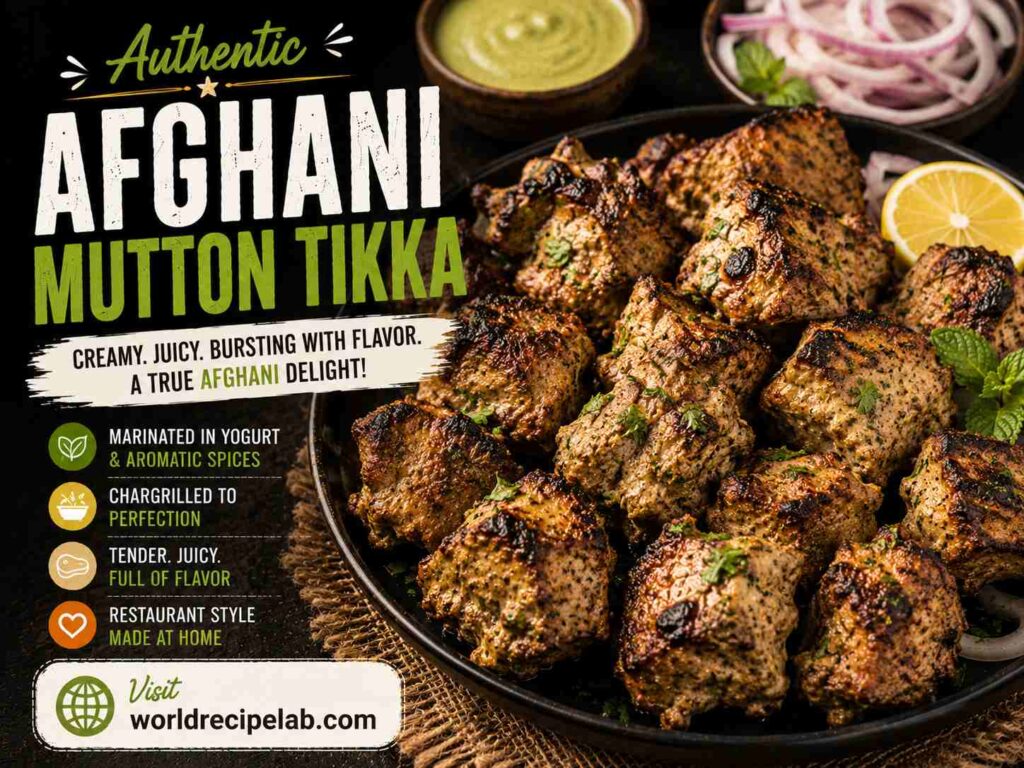
You can prepare this home-style version in an oven, on an outdoor grill, in an air fryer, or on a heavy skillet. A traditional tandoor is not essential, although each cooking method produces a slightly different texture and level of smoky char.
This recipe uses white pepper, cardamom, and garam masala rather than a heavy red-chilli marinade. The result is a rich, aromatic kebab that pairs well with mint chutney, sliced onions, lemon wedges, and freshly made naan.
Many familiar Indian kebabs use chilli powder, turmeric, or a strongly coloured marinade. This Afghani-style version takes a different approach, emphasising the richness of yogurt, cream, cashew paste, and gently aromatic spices.
The marinade has three important components:
The name Afghani mutton tikka is used for several restaurant and home-style preparations. This recipe is an Afghani-style creamy kebab rather than a claim to represent every traditional Afghan preparation.
In a large bowl, combine the hung curd, fresh cream, cashew paste, ginger-garlic paste, white pepper, garam masala, cardamom powder, lemon juice, melted ghee, and salt.
Mix until the ingredients form a smooth, thick marinade. If the yogurt is watery, strain it before measuring so the mixture coats the mutton instead of running off.
Cut the mutton into reasonably even pieces so they cook more consistently. Add them to the marinade and mix thoroughly, coating every piece.
Cover and refrigerate for at least 6 hours. Overnight marination is also an option, provided the meat remains refrigerated.
Do not leave raw mutton marinating on the kitchen counter. Keep it refrigerated at 4°C (40°F) or below.
Boneless shoulder pieces cut into evenly sized chunks are a practical choice for kebabs. They have enough connective tissue and flavour to suit this preparation, although they may require more cooking time than tender cuts.
Bone-in ribs can also be used, but they are harder to cook evenly on skewers and may take considerably longer to become tender.
Important: The cooking times below are estimates, not guarantees that the mutton is cooked through. Tougher cuts may need a separate covered braising stage before grilling or roasting.
Small, tender boneless pieces may cook in roughly 25–30 minutes, but larger or tougher pieces can take longer.
Allow extra time for bone-in cuts. Do not rely on surface colour alone to determine whether the meat is cooked.
This method is particularly useful when cooking without an oven or outdoor grill. Tougher pieces may need substantially longer than 10–15 minutes under the lid.
An air fryer works best with relatively small, evenly cut boneless pieces. Tough bone-in mutton may be better cooked until tender using a covered cooking method before finishing in the air fryer.
Cooking time depends on the size of the pieces, the cut of meat, the amount of bone, and the appliance.
For whole cuts of goat or mutton, use a food thermometer and follow recognised guidance for safe minimum internal temperature. The USDA recommends 63°C (145°F) followed by a three-minute rest for whole cuts of lamb or goat. Ground mutton requires 71°C (160°F).
These minimum temperatures address food safety; tougher cuts may need additional cooking to become tender. For bone-in pieces, check the thickest edible section without touching the bone.
For a smoky finish, use a proper food-safe dhungar technique only if you can handle hot charcoal safely.
Keep hot charcoal away from flammable surfaces and never use charcoal indoors unless the setup is specifically designed for safe indoor use. Burning charcoal produces carbon monoxide, an odourless, potentially fatal gas. Never burn charcoal in an enclosed or poorly ventilated room.
This step is optional. A well-browned grill or skillet finish can provide plenty of flavour without charcoal smoke.
Transfer the hot mutton tikka to a serving platter. Add onion rings, lemon wedges, and mint chutney.
Serve with butter naan, rumali roti, or jeera rice. A little lemon juice just before eating helps balance the richness of the cream and ghee.
Use thick, plain Greek yogurt. If you have regular curd, strain it through a clean muslin cloth or fine sieve in the refrigerator until it becomes thick.
Blanched almond paste or white melon seed paste can provide a similar richness. You can also omit the paste, although the marinade will be less creamy.
Malai can be used if it is smooth and suitable for mixing into a marinade. Replacing cream with milk will make the marinade thinner, so it is not a direct one-to-one substitute.
Use a smaller quantity of freshly ground black pepper if white pepper is unavailable. The flavour will be more pronounced.
Butter can be used for basting. A neutral cooking oil is another option, although it will not provide the same buttery flavour.
Thick, unsweetened coconut yogurt and coconut cream can replace the dairy ingredients. The flavour will be different, and the marinade may brown differently. Check the consistency before coating the meat.
Chicken can be prepared with a similar marinade, but it needs its own cooking time and temperature checks. Cook poultry to an internal temperature of 74°C (165°F). Do not apply mutton cooking times to chicken.
Because the kebabs are creamy and rich, fresh, tangy accompaniments work particularly well.
For another grilled mutton dish, try Mutton Seekh Kebab. If you prefer a slow-cooked curry, explore Dhaba-Style Mutton Curry.
Yes. Cover the bowl and keep it refrigerated. Overnight marination can be convenient, but it does not replace proper cooking. Avoid leaving the raw meat at room temperature.
The meat may be from a tough cut, the pieces may be too large, or the cooking time may be insufficient. Mutton often needs longer cooking to soften its connective tissue. If the exterior is browning too quickly, reduce the heat and continue cooking until tender.
Yes. A heavy skillet or tawa works well for smaller boneless pieces. An outdoor grill or air fryer is also suitable, provided the meat cooks through without the marinade burning.
Yes. The kebabs will still work, although the marinade will be less rich. Almond paste or white melon seed paste are alternatives.
This version is mildly spiced rather than chilli-heavy. White pepper adds warmth, while cardamom and garam masala provide aroma. Adjust the pepper to suit your preference.
Yes. Freeze the raw mutton in its marinade in a sealed, freezer-safe container. For best quality, use it within about two to three months. Thaw it in the refrigerator before cooking, and do not reuse the raw marinade as a serving sauce unless it has been thoroughly cooked.
Choose a suitable cut, avoid excessive heat, and baste lightly during cooking. Most importantly, cook the meat until it is safe and tender without leaving it over intense heat for longer than necessary.
Afghani-style mutton tikka combines a creamy yogurt marinade with aromatic spices and a browned, smoky finish. The key is to use thick yogurt, marinate the meat under refrigeration, and choose a cooking method that suits the cut.
Boneless shoulder pieces are a practical option for home cooking. If you use tougher or bone-in pieces, allow extra time and check the meat rather than relying on a fixed cooking duration.
Serve the kebabs hot with mint chutney, lemon wedges, onions, and your favourite flatbread for a satisfying meal.
Hung curd can be replaced with thick Greek yogurt.
Cashew paste may be substituted with almond paste or white melon seed paste.
For a dairy-free version, use coconut yogurt and coconut cream.
Use fatty cuts like shoulder or ribs for the juiciest texture.
Regular basting with butter or ghee prevents the tikka from drying out.
The optional charcoal smoke technique gives authentic restaurant-style aroma.
Serve with butter naan, rumali roti, or jeera rice for a complete meal.
A light sprinkle of chaat masala before serving adds extra flavor.