

Chicken Shahi Korma is a rich and aromatic chicken curry made with yogurt, nuts, whole spices, cream, and saffron. The gravy is smooth and mildly spiced, with a deep nutty flavor and a gentle floral aroma from saffron and optional kewra or rose water.
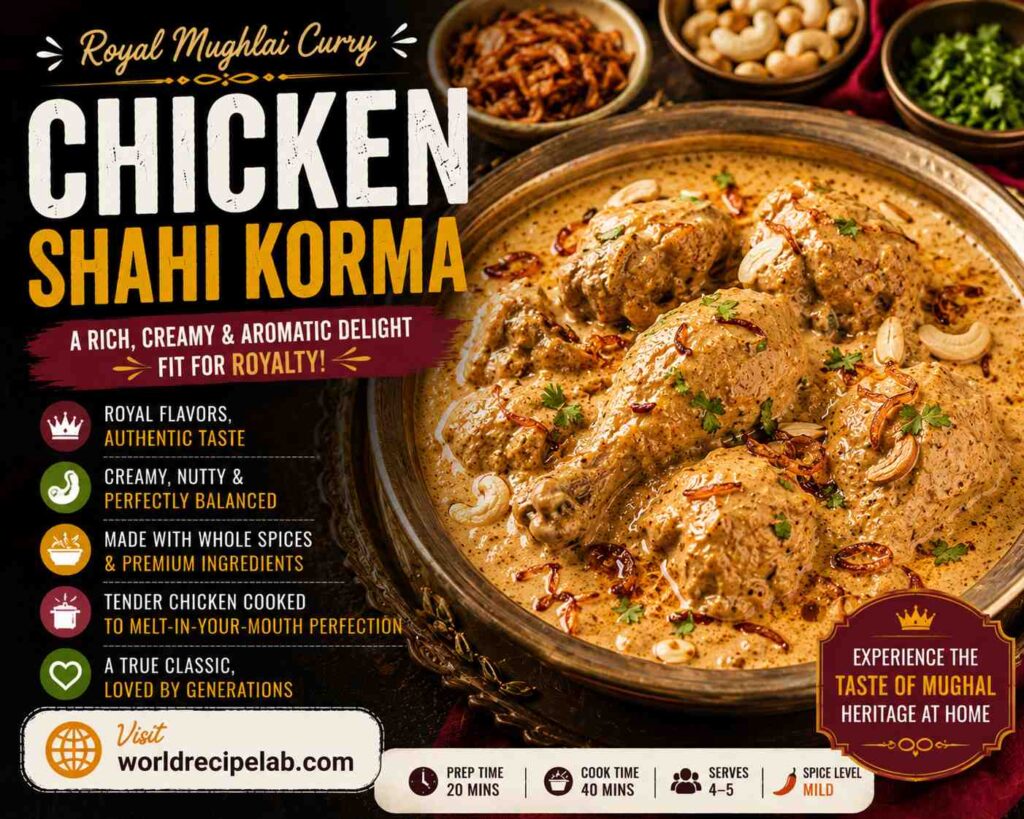
Unlike tomato-based chicken curries, Shahi Korma gets most of its richness from yogurt, nuts, cream, and slow cooking. It is a beautiful choice for a special dinner, family meal, or Mughlai-style feast.
Chicken Shahi Korma is a Mughlai-style chicken curry prepared with marinated chicken and a rich gravy made from onions, soaked nuts, yogurt, aromatic spices, cream, and saffron.
The word shahi means "royal," while korma refers to a style of cooking in which meat is gently cooked with a rich, aromatic sauce. Korma developed through the Persianate and Mughal culinary traditions of South Asia and later became part of many regional Indian cuisines.
This chicken version uses bone-in chicken for a flavorful and tender curry, although boneless chicken can also be used with adjusted cooking time.
Chicken Shahi Korma is:
The finished gravy should be thick enough to coat the chicken without becoming overly heavy.
If you enjoy rich Indian chicken curries, you may also like our Chicken Makhani and Chicken Korma.
This recipe builds flavor in several stages rather than relying on a large amount of spice.
Marinated chicken adds flavor from the beginning.
Golden onion paste gives the gravy body and natural sweetness.
Cashew or almond paste creates the characteristic richness of korma.
Yogurt adds mild acidity and helps create a smooth curry base.
Cream and saffron finish the dish with a luxurious texture and aroma.
The key is to cook the gravy gently after adding the yogurt and cream. High heat can cause yogurt to separate and make the sauce look grainy.
15 minutes
30 minutes
About 50 minutes
About 1 hour 35 minutes
4
Main Course
Indian, Mughlai
Add the chicken, thick yogurt, ginger-garlic paste, salt, turmeric, and red chili powder to a mixing bowl.
Mix thoroughly so every piece of chicken is coated.
Cover and refrigerate for at least 30 minutes.
For deeper flavor, the chicken can be marinated longer, but bring it out of the refrigerator before cooking so it is not extremely cold when it goes into the pan.
Heat the ghee in a heavy-bottomed pan over medium heat.
Add the sliced onions and cook until they become evenly golden.
Do not rush this step. Burnt onions can make the entire gravy bitter.
Remove the onions from the pan and allow them to cool slightly.
Transfer them to a blender and blend into a smooth paste, adding a small amount of water if needed.
Set aside.
Add the soaked cashews or almonds to a blender.
Add the optional poppy seeds and blend into a smooth paste.
Add a little water if necessary, but avoid making the paste too thin.
A smooth nut paste helps create the silky texture associated with this style of korma.
Use the same heavy-bottomed pan.
Add the bay leaf, cloves, and cinnamon stick.
Cook briefly until fragrant.
Add the ginger-garlic paste and sauté until the raw aroma disappears.
Add the prepared onion paste.
Cook for about 3–4 minutes, stirring regularly.
Add the nut paste and continue cooking until the mixture becomes well combined and the fat begins to separate around the edges.
If the mixture becomes too thick while cooking, add a small splash of water.
Add the marinated chicken to the pan.
Cook over medium-high heat for 5–7 minutes, turning the pieces occasionally so they become coated with the gravy.
Reduce the heat.
Cover the pan and simmer for about 10 minutes.
The chicken will continue cooking as the sauce develops.
Lower the heat.
Whisk the remaining ½ cup yogurt until smooth.
Add it gradually to the pan while stirring continuously.
Keeping the heat low at this stage helps prevent the yogurt from splitting.
Add the cream and cardamom powder.
Continue cooking gently for about 25–30 minutes, or until the chicken is tender and the gravy has become rich and creamy.
The exact cooking time can vary depending on the size of the chicken pieces and the type of pan used.
Pour in the saffron-infused milk.
If using rose water or kewra essence, add a few drops.
Stir gently and simmer for another 2 minutes.
Taste and adjust the salt if necessary.
The finished gravy should be thick, smooth, aromatic, and able to coat the chicken.
Turn off the heat.
Garnish with chopped fresh coriander and slivered almonds.
Serve Chicken Shahi Korma hot with naan, roomali roti, laccha paratha, or saffron rice.
The onion paste is one of the main sources of flavor and body in the gravy. Cook the onions until golden rather than dark brown or burnt.
Thick yogurt gives the curry a smoother texture and reduces excess water in the gravy.
Bring the yogurt closer to room temperature and whisk it before adding it to the hot curry.
This is one of the most important steps.
Adding cold yogurt directly to a very hot pan can cause it to split. Lower the heat and add the yogurt gradually while stirring.
Large pieces of nuts can make the gravy grainy. Blend the cashews or almonds into a smooth paste.
Shahi Korma is about aroma and richness rather than extreme heat. The spices should support the nuts, yogurt, chicken, and saffron instead of dominating them.
Both work well.
Cashews produce a creamy, slightly sweet gravy and are particularly convenient for creating a smooth sauce.
Almonds provide a slightly deeper nutty flavor.
You can use either depending on what you have available.
For a particularly smooth korma, soak the nuts before blending.
Yes.
If you need a nut-free version, you can build the gravy around thick yogurt and cream and use another suitable thickener if needed.
Sunflower seed paste is another option for adding body while keeping the nut-free approach.
The flavor will not be exactly the same as a nut-based korma, but the curry can still have a rich and smooth texture.
Yes.
Cream contributes extra richness, but it is not the only source of body in this recipe.
The yogurt and nut paste already create a substantial gravy. If you leave out the cream, expect the finished curry to be slightly less rich and creamy.
Kewra is optional.
You can leave it out completely if you do not have it.
A small amount of rose water can provide a different floral aroma, but it should be used sparingly because too much can overpower the curry.
Because the gravy is rich, simple breads and lightly seasoned rice work especially well.
Soft naan is ideal for scooping up the creamy korma gravy.
Thin roomali roti provides a lighter pairing and works especially well with rich Mughlai-style curries.
The flaky layers of laccha paratha are excellent with thick korma gravy.
Lightly fragrant rice complements the saffron and aromatic spices in the curry without competing with them.
For a simple everyday meal, steamed rice is enough.
If you are planning a larger Indian feast, pair the korma with Chicken Biryani for a more substantial meal.
These two dishes are often grouped together because both are rich chicken curries, but their flavor profiles are quite different.
| Feature | Chicken Shahi Korma | Chicken Tikka Masala |
|---|---|---|
| Main base | Yogurt and nuts | Tomato-based sauce |
| Flavor | Rich, nutty and aromatic | Tangy, savory and spiced |
| Cream | Common | Common |
| Nuts | Common | Usually not essential |
| Tomato | Not used in this recipe | Usually central |
| Spice profile | Mild to moderate | Moderate and often more pronounced |
| Texture | Smooth and rich | Thick and tomato-forward |
The main difference is the base. Shahi Korma relies on yogurt, nuts, aromatics, and gentle cooking, while tikka masala is generally built around a tomato-based sauce and cooked or grilled chicken pieces.
The terms can overlap because korma is a broad family of dishes rather than one single fixed recipe.
A Shahi Korma generally emphasizes a richer combination of nuts, dairy, aromatic spices, saffron, and sometimes floral ingredients.
Different regions and cooks prepare korma differently, so there is no single universal ingredient list.
This recipe takes a rich Mughlai-style approach.
For another version, see our Chicken Korma recipe.
Allow leftover korma to cool before transferring it to an airtight container.
Keep refrigerated and use within 3 days.
Reheat gently over low to medium heat.
If the gravy has thickened considerably in the refrigerator, add a small splash of water while reheating.
Avoid aggressive boiling because the dairy-based sauce can separate.
The chicken and gravy can be frozen, although the texture of dairy-based sauces may change slightly after thawing.
If freezing, cool the curry promptly, store it in a suitable airtight freezer container, and thaw it safely in the refrigerator before reheating.
Dark or burnt onions can make the gravy bitter. Aim for an even golden color.
This can cause the yogurt to split.
Lower the heat and add whisked yogurt gradually.
Kewra and rose water are powerful ingredients. A small amount is enough.
A coarse paste can give the gravy an unpleasant texture.
Blend until smooth.
Shahi Korma benefits from gentle cooking. Hard boiling can affect the texture of the yogurt and cream-based sauce.
Yes.
In fact, preparing the curry a little ahead of serving can allow the flavors to settle.
If making it ahead, cool and refrigerate it safely, then reheat gently before serving.
Add a small splash of water if the gravy becomes too thick.
Chicken Shahi Korma is generally mild to moderately spiced.
The red chili powder contributes heat and color, but the yogurt, cream, nuts, and aromatic spices balance the overall flavor.
For a milder curry, reduce the chili powder.
For more heat, add a little extra chili according to your preference.
Korma belongs to the long culinary history of South Asia and is strongly associated with Mughal and Persian-influenced cooking traditions.
The cooking style developed around gently braising meat with aromatics, dairy, nuts, and spices. Over time, korma evolved into many regional forms, with recipes varying in ingredients, consistency, and spice level.
Chicken became a popular choice for korma in many modern Indian kitchens because it cooks more quickly than traditional red meats.
The term korma is related to the Persian culinary tradition of braising or slow cooking, while the Indian versions developed their own distinctive ingredients and techniques.
So rather than treating one recipe as the single "authentic" korma, it is more accurate to understand Shahi Korma as a rich Mughlai-style interpretation of a broader South Asian dish family.
Chicken Shahi Korma is made with chicken, yogurt, onions, cashews or almonds, aromatic spices, cream, and saffron. This version also uses ginger-garlic paste and optional kewra or rose water.
It is usually mild to moderately spicy. The amount of chili powder can be adjusted according to taste.
Yogurt can split when it is added to a very hot pan or cooked too aggressively. Whisk the yogurt first, lower the heat, and add it gradually while stirring.
Yes. Boneless chicken can be used, although it may cook faster than bone-in chicken. Avoid overcooking it because lean chicken can become dry.
Yes. Use a suitable nut-free thickener such as sunflower seed paste, along with yogurt and cream, although the flavor will differ from traditional nut-based versions.
Yes. Cashews and almonds can both be used. Cashews produce a particularly smooth and creamy gravy, while almonds provide a slightly deeper nutty flavor.
Serve it with naan, roomali roti, laccha paratha, saffron rice, pulao, or plain steamed rice.
It can be frozen, although the texture of the dairy-based gravy may change slightly after thawing. Thaw it safely in the refrigerator and reheat gently.
Chicken Shahi Korma is a good example of how a rich curry can build flavor without relying on extreme heat.
The combination of golden onions, yogurt, nuts, aromatic spices, cream, and saffron creates a smooth gravy with layers of flavor. The most important techniques are simple: cook the onions carefully, blend the nut paste smoothly, add yogurt over low heat, and give the chicken enough time to become tender.
Serve it with naan, roomali roti, paratha, or fragrant rice for a satisfying Mughlai-style meal.
If you enjoy rich Indian chicken dishes, continue exploring Chicken Galouti Kebab, Chicken Makhani, and Chicken Biryani from World Recipe Lab.
Bring yogurt to room temperature before cooking to prevent curdling.
Blend the onion and nut pastes until completely smooth for a silky texture.
Cook on low heat for the best flavor and creamy consistency.
Cashews and almonds can be used interchangeably.
Rose water or kewra essence is optional but adds an authentic Mughlai aroma.
Leftover Chicken Shahi Korma tastes even better the next day and can be served with pulao, naan, or wraps.