

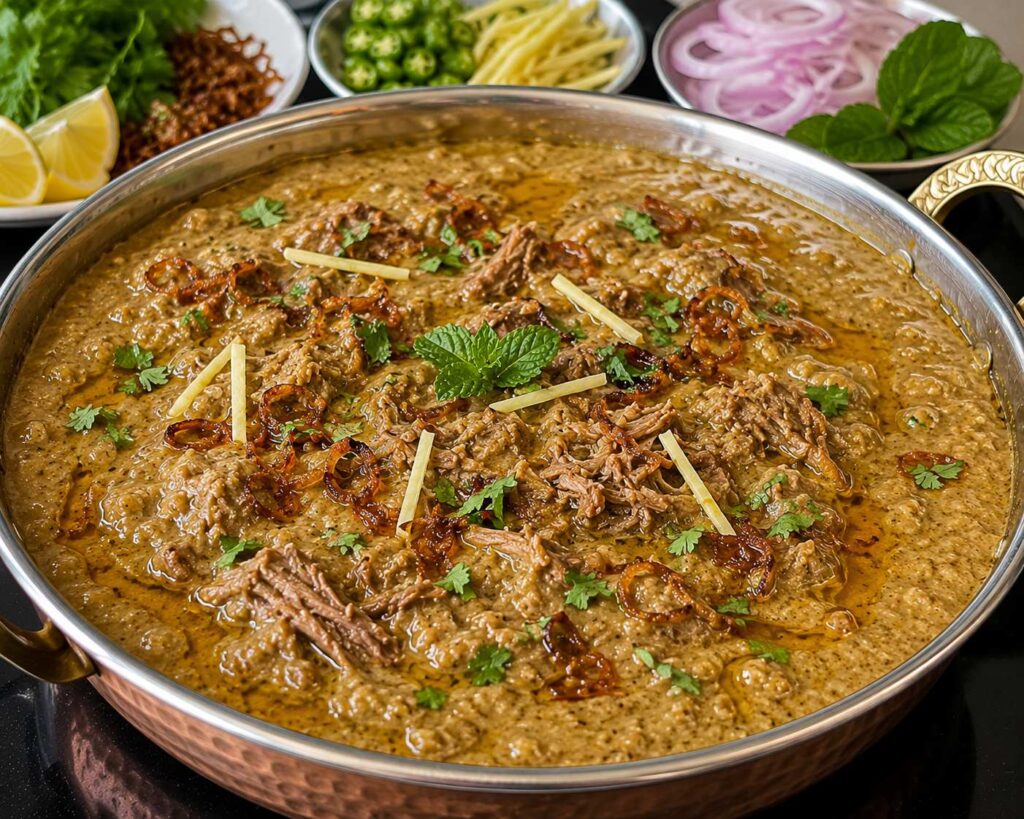
Mutton haleem is a slow-cooked dish of meat, cracked wheat, lentils, ghee, and spices that gradually transforms into a thick, spoonable mixture. The grains and lentils provide the body, while the mutton is cooked until tender enough to shred and blend into the mixture.
It is especially associated with Ramadan in South Asia and is commonly served for iftar. The finished haleem should be thick and cohesive rather than watery, with the meat, grains, and lentils thoroughly incorporated.
The key is not one complicated technique. It is giving each component enough time to become soft before bringing everything together.
A good haleem depends on three things:
You can leave the mixture slightly coarse if you prefer some texture, or blend it more thoroughly for a smoother haleem.
For another slow-cooked mutton dish with a completely different texture and spice profile, see our best mutton recipes at home.
 |
| Traditional mutton haleem served with crispy fried onions, lemon wedges, and fresh coriander |
Prep Time: 25 minutes
Cook Time: 4 hours 30 minutes
Soaking Time: 2 hours
Total Time: 6 hours 55 minutes
Servings: 6
Course: Main Course
Cuisine: Hyderabad, Indian
The soaking time is separate from the cooking time. If you soak the grains and lentils ahead of time, the actual cooking process becomes easier to manage.
Combine the cracked wheat, toor dal, chana dal, and moong dal in a large bowl. Cover them with water and soak for 2–3 hours.
Soaking softens the grains and lentils before cooking, which helps them break down more easily later.
Drain them before adding them to the saucepan.
Heat 2 tablespoons of ghee in a pressure cooker over medium heat.
Add the chopped onion and cook until golden brown. Add the ginger-garlic paste and cook for 2–3 minutes, stirring so it does not catch on the bottom.
Add the mutton, turmeric, red chili powder, black pepper, and salt. Sauté for about 10 minutes.
Pour in 3 cups of water, close the pressure cooker, and cook for 4–5 whistles, or until the mutton is tender enough to shred.
Cooking time can vary between pressure cookers and cuts of mutton, so tenderness is more useful than relying on the whistle count alone.
Transfer the soaked wheat and lentils to a large saucepan.
Add 5 cups of water and cook for approximately 30–40 minutes, or until the grains and lentils are very soft and mushy.
Mash them thoroughly or blend them into a smooth paste.
If the mixture looks too thick while cooking, add a little water as needed. The goal at this stage is softness rather than the final haleem consistency.
Once the mutton is tender, shred it with a spoon or fork.
You can also pulse it gently in a blender or food processor if you want the meat to become more integrated into the haleem.
Do not turn it into a completely smooth purée if you prefer some visible meat texture.
Add the shredded mutton and cooked wheat-lentil mixture to a large heavy-bottomed pot.
Add the remaining ghee and 1½ tsp garam masala.
Mix thoroughly.
At this point, the mixture may still look like separate components. The final slow simmer is what brings the texture together.
Cook the haleem over low heat for 1–2 hours, stirring frequently.
This stage deserves patience. The mixture should gradually become thick, cohesive, and smooth, with the mutton incorporated into the grains and lentils.
Keep scraping the bottom as you stir, especially if using a heavy, thick mixture. Haleem can catch on the bottom once it becomes very thick.
If it becomes excessively thick before the desired texture is reached, loosen it with a small amount of hot water.
Taste the haleem and adjust the salt if necessary.
Transfer it to serving bowls and finish with:
Serve hot.
Haleem should be thick enough to sit on a spoon but loose enough to eat comfortably.
If yours is too thin, continue cooking uncovered over low heat while stirring regularly.
If it is too thick, add a small amount of hot water and mix well.
If you want a smoother texture, use a hand blender briefly during the cooking process. Avoid over-blending if you want some texture from the meat and grains.
The final consistency also changes as haleem cools, so do not reduce it excessively while it is still very hot.
Haleem is flexible, but substitutions change the final texture.
Steel-cut oats or broken barley can be used as alternatives. Cracked wheat gives the more traditional grain base, while oats tend to produce a softer, more porridge-like texture.
If using barley, remember that barley contains gluten.
Use masoor dal instead. It cooks quickly and blends easily, although it gives the mixture a slightly different color and flavor.
Yes. Minced mutton is particularly convenient because it cooks and breaks down easily, making it useful when you want a more uniform haleem.
Yes. Bone-in mutton can be used for a richer meat base, but the bones must be removed completely before the final blending and simmering stage.
Add slit green chilies during the cooking process. This gives a fresher chili character than simply increasing the amount of red chili powder.
Keep it simmering uncovered over low heat. Stir frequently until excess moisture evaporates.
Add hot water gradually rather than pouring in a large amount at once. Mix thoroughly after each addition.
They need more cooking time. Continue simmering with enough water to prevent the mixture from sticking.
The meat has not become tender enough. Continue cooking until it can be easily broken apart with a spoon or fork.
Haleem becomes increasingly prone to sticking as it thickens. Lower the heat and stir more often, making sure your spoon reaches the bottom of the pot.
Check the salt first. If the seasoning is correct, a squeeze of lemon at serving time can add brightness and balance the richness.
Haleem is substantial enough to serve on its own, but the garnishes are important because they add contrast to its thick texture.
A classic serving combination includes:
It can also be served with naan, roomali roti, or paratha.
For a larger Ramadan spread, pair it with a small appetizer such as mutton seekh kebab rather than adding another heavy curry to the meal.
Yes. Haleem is well suited to batch cooking.
After cooking, cool it promptly and refrigerate leftovers in a covered container. When reheating, add a little water if the haleem has thickened substantially.
Reheat gently until steaming hot throughout, stirring regularly so the thick mixture does not stick to the pan.
The original recipe notes that haleem freezes well. If freezing, divide it into practical portions rather than repeatedly freezing and thawing the entire batch.
Haleem belongs to a broader family of slow-cooked meat-and-grain dishes associated with West and Central Asian culinary traditions. Variations of these dishes travelled and developed across the Middle East and South Asia.
In India, Pakistan, and Bangladesh, haleem developed into numerous regional versions. Hyderabadi haleem is particularly well known and has become closely associated with Ramadan and the city's food culture.
Rather than treating every modern haleem recipe as one fixed traditional formula, it is more accurate to think of haleem as a dish with regional variations. The proportions of meat, wheat, lentils, spices, and cooking methods can differ considerably.
Yes. A pressure cooker is useful for making the mutton tender before combining it with the cooked grains and lentils. The final slow simmer should still be given enough time to develop the characteristic thick texture.
This recipe has a 4-hour 30-minute cooking time in the WPRM recipe card, including the separate cooking stages and long final simmer. Actual time can vary with the mutton cut, cookware, and heat level. Judge the meat and grain texture rather than relying only on the clock.
Boneless mutton works particularly well for this recipe because it is easy to shred and incorporate. Minced mutton is another practical option. Bone-in mutton can also be used if the bones are removed before finishing.
Yes, although the result will not have exactly the same traditional texture. Steel-cut oats are a better choice than quick oats when you want the grains to retain some body.
The wheat and lentils continue to absorb moisture as the haleem cools. Add a little water during reheating and stir until the desired consistency returns.
The best part of mutton haleem is the transformation that happens during the long cooking process. What begins as separate meat, grains, lentils, spices, and ghee becomes one cohesive dish with a thick, spoonable texture.
For Ramadan, it works particularly well as a make-ahead main dish because the individual components can be prepared before the final slow simmer. And if you're building a larger mutton menu, you can explore more options in our collection of best mutton recipes at home.
The recipe takes time, but most of that time is cooking rather than complicated hands-on preparation. Once the mutton is tender and the grains and lentils are completely soft, the final slow simmer does most of the work.
• Minced mutton cooks faster and blends easily into the haleem.
• Bone-in mutton provides more flavor, but remove the bones after cooking.
• Steel-cut oats or broken barley can replace cracked wheat.
• Masoor dal can be used instead of moong dal.
• Longer slow cooking creates a creamier and richer texture.
• Stir frequently during the final simmer to avoid sticking.
• Haleem tastes even better the next day and freezes well for future meals.
• Serve with naan, roomali roti, paratha, or enjoy it on its own.