

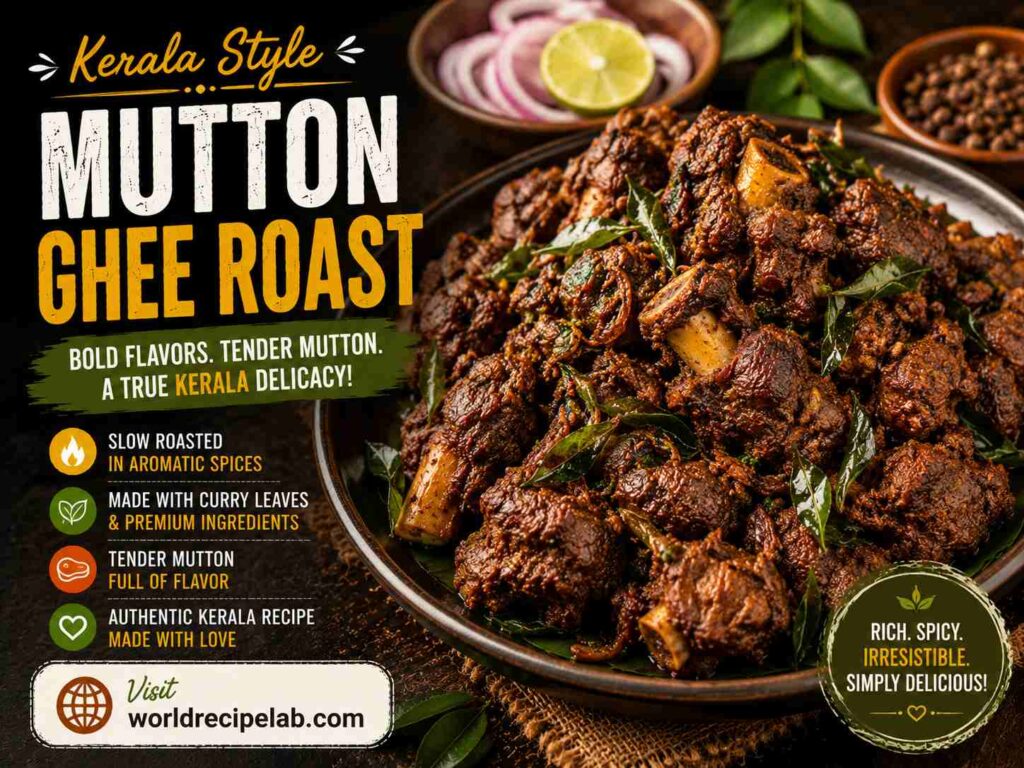
Kerala-style mutton ghee roast is a rich, intensely spiced dry mutton dish made with goat meat, ghee, roasted whole spices, curry leaves, chilies and a thick masala.
Unlike a mutton curry with plenty of gravy, a ghee roast is finished by cooking the meat with the masala until the sauce reduces and clings closely to each piece. The combination of roasted coriander, fennel, dried chilies and pepper gives the dish its deep, warming character, while ghee adds richness.
This version uses 500 g bone-in mutton, a short yogurt marinade and a freshly roasted spice paste. It is especially good with Malabar parotta, appam, neer dosa or ghee rice.
There are four important parts to this preparation.
First, the mutton is marinated. Yogurt, lemon, ginger-garlic, turmeric and chili season the meat before cooking.
Second, the whole spices are roasted. Coriander, fennel, dried chilies, pepper and the other spices are heated until aromatic before being ground into the masala.
Third, the mutton is cooked before the final roast. This makes it easier to get tender meat without burning the concentrated spice paste.
Finally, the cooked mutton is roasted in ghee and masala. The cooking liquid is reduced as needed until the masala becomes thick enough to coat the meat rather than sit underneath it as gravy.
Ghee roast is strongly associated with the coastal Karnataka tradition, particularly the Kundapura/Mangalorean style of ghee roast. Similar preparations and adaptations are now found across South India.
This recipe is specifically written as a Kerala-style mutton version, using goat meat, curry leaves, coconut and a pepper-forward spice mixture. It should not be presented as the single original form of ghee roast.
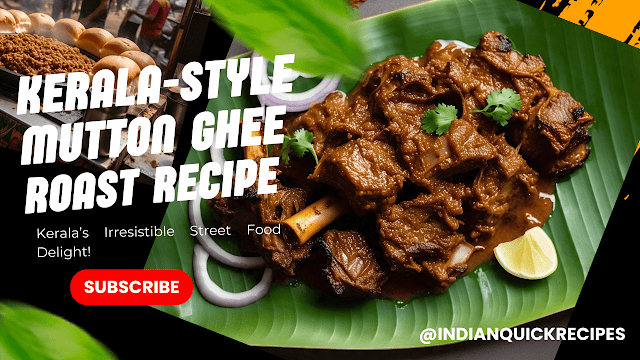 |
| Kerala-style mutton ghee roast served hot with Malabar parotta and lemon slices |
Place the mutton in a bowl and add turmeric, red chili powder, salt, yogurt, ginger-garlic paste and lemon juice.
Mix thoroughly so the marinade coats the meat.
Cover and refrigerate for at least 1 hour. You can marinate it overnight if convenient.
Before cooking, allow the meat to lose some of its refrigerator chill while you prepare the remaining ingredients.
Transfer the marinated mutton to a pressure cooker or heavy-bottomed pot.
Add a small amount of water and cook until the meat is about 90% tender.
The exact cooking time depends on the cut, age of the animal, pressure cooker and size of the pieces, so don't rely on a single fixed number of minutes.
Keep the cooking liquid instead of discarding it. You'll use a little of this stock later if the masala becomes too dry.
The meat should be almost tender at this stage but still able to withstand the final roasting.
While the mutton cooks, place the coriander seeds, fennel seeds, dried red chilies, peppercorns, cinnamon, cloves and cardamom in a dry pan.
Roast over medium-low heat until the spices become fragrant.
Do not let the chilies or spices turn dark and bitter.
Add the garlic, ginger, chopped onion and grated coconut, if using. Continue cooking until the fresh ingredients soften and take on a little color.
Remove from the heat and allow the mixture to cool.
Transfer the roasted mixture to a blender or mixer grinder.
Grind into a thick paste.
You don't want a watery masala. A concentrated paste makes it easier to achieve the characteristic dry coating during the final roast.
Heat the ghee in a heavy-bottomed pan or kadai over medium heat.
Add the fresh curry leaves and let them sizzle briefly.
Add the ground masala.
Cook patiently, stirring regularly, until the raw smell disappears and the masala becomes darker and more concentrated.
You should see the ghee beginning to separate around the edges.
If the mixture starts catching on the bottom before it has cooked properly, reduce the heat and add a small splash of the reserved mutton stock.
Add the nearly tender mutton to the roasted masala.
Turn the pieces gently so they become completely coated.
Cook over low to medium-low heat for approximately 15–20 minutes, stirring from time to time.
Add small amounts of the reserved stock only when necessary. The goal is not to create a curry.
Continue roasting until the masala becomes thick, dark and clings closely to the mutton.
Taste and adjust the salt.
Add a few more curry leaves if desired and give the mutton a final few minutes in the pan.
The finished dish should have tender mutton covered in a concentrated spice coating with visible ghee around the masala.
Serve hot.
This is where the dish changes from mutton curry to ghee roast.
Don't add all of the reserved cooking stock at once. Start with a small amount and let it cook away.
If the pan is still watery, continue cooking uncovered over moderate heat.
If the masala becomes too dry before the meat is ready, add a tablespoon or two of stock and continue roasting.
The final texture should be thick, moist and clingy, rather than either watery or completely dry.
The dried chilies control both the heat and the color of the masala.
For a brighter red color with moderate heat, use a milder variety such as Byadagi or Kashmiri chili.
For more heat, combine milder dried chilies with hotter varieties.
You can also simply reduce the number of dried chilies if you're cooking for people who prefer a gentler spice level.
Yes.
The grated coconut is optional in this version. It adds body and a subtle nutty richness to the masala, but the roast can still be made without it.
If you omit the coconut, pay attention to the consistency of the spice paste and use less cooking stock during the final roasting stage if necessary.
Goat meat is the better choice if you want the character of an Indian mutton preparation.
Lamb shoulder can also be used, but the cooking time can differ. Cook according to tenderness rather than transferring the goat-meat cooking time directly to lamb.
For this particular recipe, bone-in pieces work well because they remain substantial during the cooking and roasting stages.
Ghee is an important part of the flavor profile, so it is the preferred fat for this recipe.
If you genuinely cannot use ghee, you can cook the dish with another neutral cooking fat, but the finished dish will no longer have the same characteristic ghee aroma.
Butter alone is not an ideal direct replacement because its water content and behavior during prolonged cooking differ from ghee.
The concentrated masala pairs especially well with breads and mild rice dishes.
Try it with:
For a South Indian meal, serve the spicy mutton alongside a milder rice or bread so the roasted masala remains the main flavor.
If you enjoy other intensely spiced mutton dishes, try our Spicy Chettinad Mutton Curry.
For a broader selection, explore these Best Mutton Recipes at Home.
The goal is a concentrated roast, not a gravy. Add the reserved stock gradually.
Roasted spices develop deep flavor quickly, but a burnt masala becomes bitter. Use moderate heat and stir regularly.
A large amount of extremely hot chili can overwhelm the coriander, fennel and pepper. Choose chilies for both flavor and heat.
Even properly cooked mutton can taste more like curry if the masala isn't reduced enough. Give the meat time to roast with the spice paste.
The mutton should be tender enough to eat comfortably, but it still needs to hold its shape during the final roasting stage.
Transfer leftovers to an airtight container and refrigerate promptly.
They can be refrigerated for up to 3 days.
To reheat, place the mutton in a pan over low to medium-low heat. Add a small splash of water or reserved stock if the masala has become too dry, and heat until thoroughly hot.
Because this dish contains a concentrated masala, gentle reheating helps prevent the meat from drying out.
No. They are related styles but should not be treated as identical recipes. Ghee roast is strongly associated with coastal Karnataka, especially Kundapura and the Mangalorean region. This recipe is a Kerala-style mutton adaptation with its own ingredient balance.
Yes. Boneless pieces can be used, although the cooking time may change. Keep the pieces relatively uniform and check them for tenderness during cooking.
It can range from moderately spicy to very hot depending on the dried chilies used. Reduce the number of chilies or choose a milder variety for a less fiery version.
Too much cooking stock is usually the main reason. Continue cooking uncovered so the excess liquid can evaporate. The final masala should be thick enough to coat the mutton.
Yes. Coconut is optional in this version and can simply be omitted.
Yes. The roasted spice mixture can be prepared and ground ahead of time. Store it covered and refrigerate if you're not using it promptly. Bring it into the cooking process according to the recipe rather than leaving the prepared paste at room temperature for an extended period.
Prep time: 15 minutes
Marination: 1 hour
Cook time: 45 minutes
Total time: 2 hours
Servings: 3
Course: Main Course
Cuisine: Indian
A good Kerala-style mutton ghee roast should sit somewhere between a curry and a completely dry fry: tender mutton, a deeply roasted spice paste, curry leaves and enough ghee to give the masala richness without leaving a pool of gravy.
The most important part is the final roast. Cook the mutton until tender, add it to the prepared masala, and give the mixture enough time to reduce and cling to the meat. That's what turns a pot of spiced mutton into a proper ghee roast.
Goat meat gives the most authentic Kerala flavor, but lamb can also be used.
Do not skip the marination step. Longer marination results in softer and more flavorful meat.
Pressure cooking is convenient, but slow cooking produces richer flavors.
Byadagi chilies provide vibrant color, while Guntur chilies add extra heat.
If unavailable, grated coconut can be omitted or replaced with 1 tsp coconut milk powder.
The masala should be thick and coat the meat rather than forming a gravy.
Serve with Malabar parotta, appam, neer dosa, ghee rice, chapati, or garlic naan.
Leftovers can be refrigerated for up to 3 days and taste even better the next day. Reheat gently with a few drops of ghee.
For variations, substitute chicken, prawns, mushrooms, or paneer and adjust cooking times accordingly.
A teaspoon of jaggery can be added during the final roast for a subtle sweet-spicy balance.