

Pani puri is one of India's most popular street-food snacks: a crisp, hollow puri filled with spiced potato and chickpeas, finished with tangy mint-coriander pani and, if you like, sweet tamarind chutney. Depending on where you are in India, you may know it as golgappa, puchka, gupchup, or pani poori.
For anyone making pani puri at home for the first time, the recipe can look more complicated than it really is. The key is to prepare each component separately: crisp puri shells, a well-seasoned filling, flavorful pani, and optional sweet chutney. Once everything is ready, assembling the pani puri takes only a few seconds.
This homemade pani puri recipe gives you two choices: make the puri shells yourself or use good-quality ready-made shells when you want a faster option. The pani can also be adjusted to make it more spicy, tangy, mild, or refreshing.
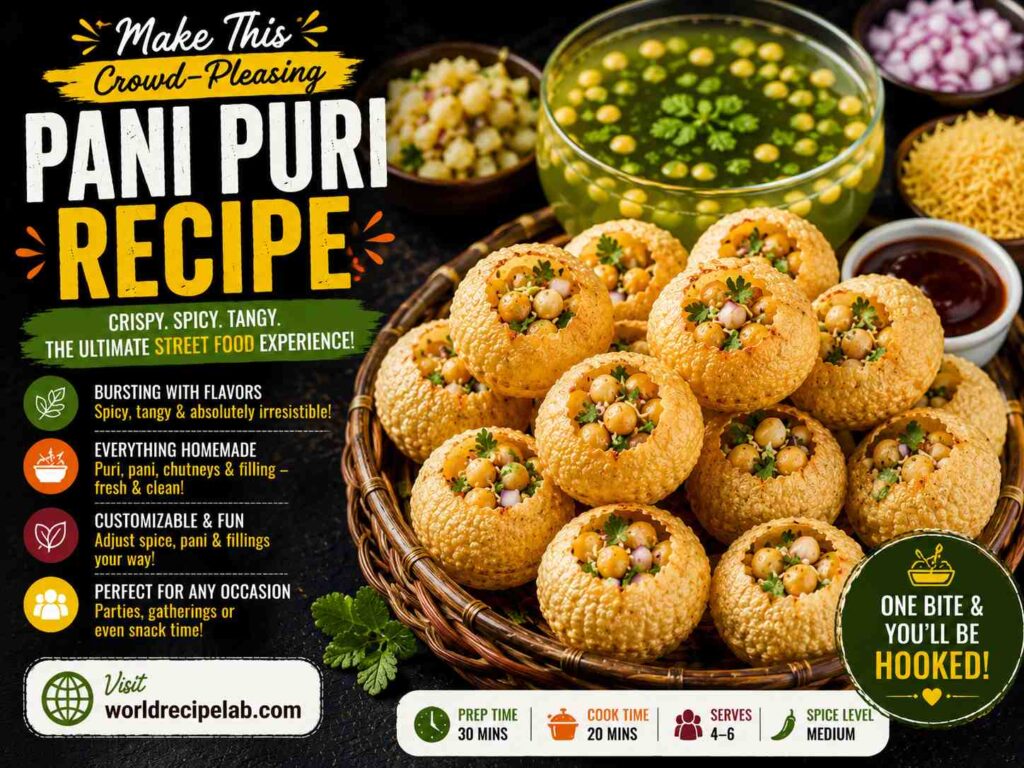
If you enjoy Indian street food, you may also like Mumbai Bhel Puri and Authentic Pav Bhaji.
Pani puri is a filled Indian street-food snack made with small, crisp, hollow puris. A hole is made in each shell, followed by a spoonful of spiced potato filling, optional chutney, and flavored pani.
The combination is what makes it distinctive. The shell provides crunch, the potato and chickpea filling adds softness and substance, while the pani brings fresh mint, coriander, chili, tamarind, cumin, and black salt.
The names change by region:
They are closely related snacks, but the filling, pani, chutney, and flavor balance can differ considerably.
You do not have to make the shells from scratch to enjoy good pani puri at home.
For readers outside India, ready-made pani puri shells may be available from Indian grocery stores, South Asian supermarkets, or international grocery delivery services. Look for shells that are dry, crisp, intact, and free from a stale or rancid smell.
Ingredient note: Sooji is fine semolina commonly used in Indian cooking. In countries where ingredient labels differ, look for fine semolina rather than coarse semolina.
The sweet pani is optional. Many people prefer spicy pani alone, while others enjoy the sweet-tangy contrast from tamarind-date chutney.
Add the sooji, salt, optional maida, and optional baking soda to a mixing bowl.
Gradually add water while kneading until you have a firm dough. Avoid making the dough soft or sticky.
Cover it and let it rest for 20–30 minutes.
The dough should be firm enough to roll thinly while still holding together without cracking.
Divide the dough into small portions.
Roll each portion into a thin circle approximately 2–3 inches in diameter.
Try to keep the thickness as even as possible. A very thick puri may not puff properly, while an excessively thin or uneven one can become fragile.
If making many puris, keep the unused dough covered so it does not dry out.
Heat oil in a deep frying pan or kadai.
Fry 2–3 puris at a time, depending on the size of your pan. Gently press them with a slotted spoon to encourage them to puff.
Fry until they are golden and crisp.
Remove them with a slotted spoon and allow them to cool completely.
Do not put warm puris directly into a storage container. Trapped steam can soften them.
Add the mint leaves, coriander leaves, green chilies, tamarind pulp, and a little water to a blender.
Blend until smooth.
Strain the mixture if you prefer a cleaner, smoother pani, then mix it with the cold water.
Add black salt, roasted cumin powder, and chaat masala.
Mix thoroughly and refrigerate until chilled.
Combine the tamarind-date chutney, jaggery syrup, black salt, and water.
Mix well and adjust the consistency according to your preference.
Keep this separate if you want each person to control how much sweet chutney goes into their pani puri.
Combine the mashed potatoes and boiled black chana or white peas in a bowl.
Season with salt, red chili powder, and chaat masala.
Mix until evenly combined, but do not turn the filling into a completely smooth paste. A little texture makes the finished pani puri more enjoyable.
Make a small hole in the top of each puri.
Add a spoonful of potato filling.
Add sweet chutney if desired.
Dip the filled puri into the chilled spicy pani or spoon enough pani inside to fill it.
Serve immediately.
The most important timing rule is simple: assemble pani puri only when you are ready to eat it.
The flavored water is arguably the part that gives pani puri its character. It should be bold enough to complement the potato filling without becoming overwhelmingly sour, salty, or spicy.
A useful way to adjust it is to dilute the blended mint-coriander mixture gradually.
Add more cold water gradually and taste again. Avoid immediately adding sugar, because the goal is to rebalance the pani rather than simply make it sweet.
Dilute it with additional cold water. You can also prepare a milder batch separately for children or guests who prefer less heat.
Check the black salt, roasted cumin, tamarind, green chili, and chaat masala. Each contributes a different flavor, so increase them gradually rather than adding a large amount of one ingredient.
Dilute it with more water and then rebalance the other flavors.
Refrigerate it before serving and add ice shortly before serving if desired.
For a party, you can prepare the pani earlier and keep it chilled in a covered container.
Pani puri is flexible, particularly when you are cooking outside India and cannot find every traditional ingredient.
The recipe allows either boiled black chickpeas or white peas. Use whichever is easier to find.
The texture and flavor will differ slightly, but both work well with the potato filling.
In the United States, Canada, Australia, and some other countries, coriander leaves are commonly labeled cilantro.
If jaggery is unavailable, a prepared tamarind-date chutney can still provide sweetness and tang. The flavor will not be exactly the same as chutney made with jaggery.
Prepared tamarind pulp is convenient, particularly for international kitchens. Tamarind concentrate can vary considerably in strength, so adjust the final pani gradually rather than assuming equal quantities will have identical intensity.
The small amount of maida in the puri dough is optional in this recipe. If you need to avoid wheat or gluten, do not assume that ordinary pani puri shells or semolina are gluten-free; check the ingredient labels carefully.
Reduce the amount for a milder pani or increase it if you prefer more heat. Since chili strength varies, taste the blended mixture before final dilution.
Yes.
Using packaged puris is one of the easiest ways to make pani puri at home. Prepare the filling, pani, and chutney yourself, then use the packaged shells for assembly.
This is especially useful when making pani puri for a gathering because rolling and frying 50–60 individual shells can take considerably more time than preparing the fillings.
The important thing is to keep packaged puris dry and tightly sealed until serving.
Crispness depends as much on storage and timing as it does on frying.
If homemade puris become soft, moisture is usually the main issue. Check whether they were fully cooled before storage and whether the container was properly sealed.
Poor puffing can happen for several reasons.
The dough may be too soft, the puris may have been rolled unevenly, or the rolled dough may be too thick or too thin.
Consistent rolling is particularly important. If one section is thicker than another, the puri may cook unevenly and fail to form the characteristic hollow pocket.
Oil temperature also matters. If the oil is not sufficiently hot, the puris can absorb more oil instead of puffing and becoming crisp.
Soft puris are usually caused by moisture.
Make sure the fried shells are completely cool before storage. Keep them in an airtight container and only add filling and pani immediately before serving.
Humidity can also affect crisp snacks, so avoid leaving the container open while preparing the rest of the meal.
A shell can break because it is too thin, unevenly fried, overfilled, or simply too fragile.
When assembling, make the opening carefully rather than crushing the top of the shell. Add a moderate amount of filling instead of forcing too much potato mixture inside.
A good puri should be crisp but sturdy enough to hold the filling and pani briefly.
Pani puri is particularly well suited to a DIY serving setup.
Prepare these components separately:
Place each component in a separate serving bowl or container.
Guests can make their own pani puri by cracking the top of a shell, adding filling, choosing sweet chutney, and adding chilled pani.
This approach is better than assembling dozens of pani puris in advance because the shells stay crisp.
For an Indian street-food menu, you can also serve Mumbai Bhel Puri or Authentic Pav Bhaji alongside the pani puri.
There is no single version of pani puri across India.
Mumbai versions commonly feature potato and may include ragda, a preparation made with cooked white peas. Spicy pani and sweet chutney are often part of the experience.
Puchka generally has a strong tangy and spicy profile. The potato filling and pani can be noticeably sharper and more savory than versions that lean heavily toward sweetness.
Delhi-style golgappa is commonly served with spiced potato or chickpea filling, flavored pani, and sometimes sweet chutney.
Gupchup is another regional name for this family of filled, crisp puri snacks. Local preparation can vary in the filling, spices, and pani.
These aren't simply different names for an identical recipe. Regional versions have developed their own flavor preferences and preparation styles.
Absolutely.
Reduce the green chili in the pani and use less red chili powder in the potato filling.
For a mixed group, the easiest approach is to prepare a moderately spiced base and offer extra chili separately. This allows people to adjust their own portion.
You can also prepare two pani options: one spicy and one mild.
Traditional pani puri is generally a vegetarian snack, and this recipe uses potatoes, chickpeas or white peas, herbs, spices, chutney, and puri shells.
If you are serving someone with specific dietary requirements, check packaged ingredients carefully, particularly for ready-made puris, chutneys, and spice blends.
This recipe can be made vegan using plant-based ingredients. The main components—puri shells, potatoes, chickpeas or peas, herbs, spices, tamarind, and chutney—are naturally compatible with a vegan preparation when the packaged ingredients contain no animal-derived additives.
If using ready-made puris or prepared chutneys, check their labels.
Yes, and preparing the components separately is the best approach.
Keep the perishable fillings and prepared pani refrigerated in covered containers.
Keep completely cooled puri shells in an airtight container at room temperature in a dry place.
Assemble only when serving.
For another Indian street-food dessert, Jalebi can make a good sweet addition to a larger menu.
Store the completely cooled puri shells in an airtight container at room temperature in a dry place.
Refrigerate the prepared potato filling and pani separately.
Do not refrigerate the crisp puris unless the specific product instructions say otherwise, because moisture in a refrigerator can compromise their texture.
Never store assembled pani puri. Once pani enters the shell, it begins to soften.
For gatherings, keep perishable fillings and prepared pani chilled and avoid leaving them at room temperature for extended periods.
It is not recommended to freeze assembled pani puri.
The crisp puri shells are best stored dry, while the prepared fillings and pani are better handled separately according to their ingredients and storage requirements.
For the best texture, make the puris and components ahead, store them separately, and assemble fresh.
The classic combination is:
Puri + potato filling + chickpeas/peas + spicy pani + sweet chutney
But you can customize the filling with ingredients such as:
These additions change the texture without changing the basic identity of the snack.
For a party, set out several toppings and let guests build their own version.
These names often create confusion for people discovering the dish outside India.
The simplest explanation is that they refer to closely related regional versions of the same broad type of snack: crisp hollow puris filled with savory ingredients and flavored water.
The exact recipe changes from place to place.
So if someone searches for a golgappa recipe, puchka recipe, or pani puri recipe, they may be looking for slightly different regional flavor profiles rather than completely different foods.
Pani puri has a long and widely discussed cultural history, but its precise origin is difficult to establish with certainty.
Stories connecting the snack to ancient historical figures or specific events are often repeated as culinary folklore rather than documented history.
What is easier to establish is its deep presence in Indian street-food culture and the way regional cooks have adapted the snack over time.
That regional diversity explains why pani puri, golgappa, puchka, and gupchup can look similar while tasting noticeably different.
Pani puri consists of crisp hollow puri shells filled with ingredients such as spiced potato and chickpeas or white peas. It is usually served with spicy mint-coriander pani and optional sweet tamarind chutney.
Prepare a firm semolina dough, roll and fry the puri shells, blend the mint-coriander pani, prepare the potato filling and optional sweet chutney, then assemble each puri immediately before eating.
They are closely related regional versions of the same type of Indian street-food snack. The main differences are usually the name, pani, filling, chutney, and regional seasoning.
This recipe uses fresh mint, coriander, green chili, tamarind pulp, black salt, roasted cumin powder, chaat masala, and cold water.
Yes. Good-quality ready-made shells are a practical shortcut and work especially well when preparing pani puri for a party.
Keep the fried shells completely dry and cool in an airtight container. Store the filling and pani separately and assemble the puris immediately before eating.
Yes. Reduce the green chili and red chili powder. You can also prepare a milder pani separately so everyone can choose their preferred spice level.
Yes. This recipe allows boiled black chickpeas or white peas for the filling. The choice changes the texture and flavor slightly but both work well.
Not automatically. This recipe includes optional maida, and semolina is made from wheat. Packaged puris and spice blends can also contain wheat or have cross-contact. Check ingredient labels carefully if gluten avoidance is required.
Yes. Prepare and store the individual components separately. Keep the pani and perishable filling refrigerated and the completely cooled puri shells sealed at room temperature. Assemble only when serving.
The secret to a satisfying plate of pani puri isn't one complicated ingredient. It is the contrast between the components.
The puri should be crisp enough to crack when you bite it. The potato filling should be seasoned but not overpowering. The pani should be cold, tangy, herbal, and spicy enough to stand up to the filling. Sweet tamarind chutney can then add another layer of flavor.
For the best results, prepare everything separately and assemble each pani puri just before eating.
That simple timing makes a noticeable difference—and it is what turns homemade pani puri, golgappa, or puchka from a collection of ingredients into the lively street-food experience the dish is known for.
- Resting the dough helps the puris puff properly.
- Allow fried puris to cool completely before storing.
- Store puris in an airtight container to maintain crispness.
- Never fill the puris in advance, as they will become soggy.
- Keep the pani chilled for authentic street-food flavor.
- For a healthier version, bake or air-fry the puris at 200°C for 6–8 minutes after lightly brushing with oil.
- Fresh sprouts, carrots, and pomegranate seeds can be added for extra nutrition and texture.
- Popular regional variations include Mumbai-style Pani Puri, Kolkata Puchka, Delhi Golgappa, and Odisha-style Gupchup.
- Multiple pani flavors such as jaljeera, raw mango, hing, or guava pani can be served for parties.
- Leftover fillings can be used to make chaat, wraps, or pani puri salad.