

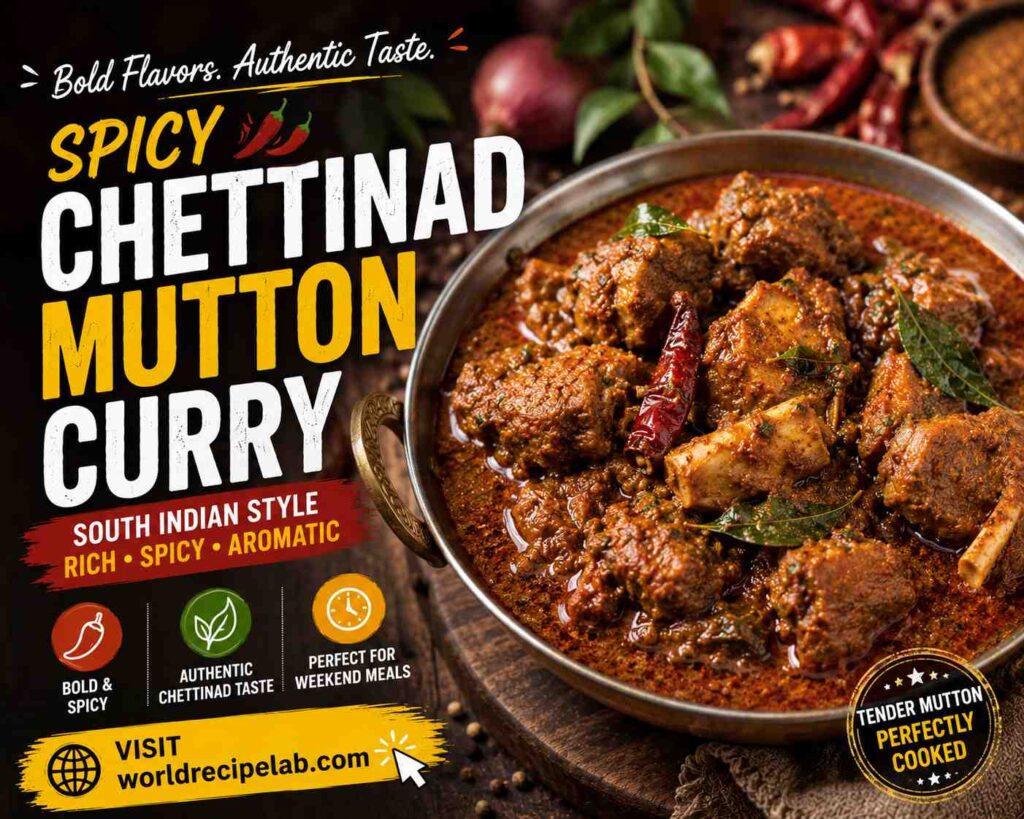
Chettinad Mutton Curry is a bold South Indian recipe made with tender mutton, freshly roasted spices, coconut, black pepper, and curry leaves. This authentic Tamil Nadu curry delivers rich flavor, aromatic masala, and a spicy kick. Follow this easy step-by-step recipe to make restaurant-quality Chettinad mutton curry at home.
Chettinad cuisine is known for its fearless use of spices, and when it comes to Chettinad mutton curry, you're in for a full-bodied, intensely flavorful experience. Hailing from Tamil Nadu's Chettinad region, this traditional dish is deeply aromatic, thanks to roasted spices, coconut, and the perfect balance of heat and depth.
Whether you’re cooking for a festive occasion or a weekend indulgence, this authentic Chettinad mutton curry recipe is a must-try for spice lovers across the globe.
 |
| Chettinad Magic in the Making – Freshly Ground Spices & Slow-Cooked Mutton Goodness! |
Chettinad mutton curry is known for the aroma that comes from freshly roasted spices. Fennel, black pepper, coriander, cumin, dried red chilies, whole spices, and coconut are roasted together, ground into a paste, and cooked with bone-in mutton to create a deeply spiced curry.
This version uses sesame oil, curry leaves, onion, tomato, and a freshly ground Chettinad-style masala. The result is a bold curry with a fragrant spice base and enough gravy to serve with rice, parotta, dosa, or idiyappam.
The heat is adjustable, but the roasted spice mixture is what gives the curry its character.
The most important part of this curry happens before the mutton goes into the pot.
The spices are gently roasted and then ground with coconut. This does more than simply add heat. It creates layers of aroma from several different spices:
The key is to roast gently. Spices and coconut can burn quickly, and burnt coconut will make the finished curry bitter.
 |
| Chettinad Mutton Curry – Spicy, Bold, and Bursting with South Indian Flavors! |
Combine the mutton with turmeric, ginger-garlic paste, and salt.
Mix well and let it rest for 30 minutes while you prepare the masala.
Keep the marinating meat refrigerated rather than leaving it at room temperature.
Roast gently until the spices become aromatic and the coconut takes on a light golden color.
Do not rush this step or use high heat. The smaller spices can burn before the larger ones are properly roasted.
Transfer everything to a plate and allow it to cool completely.
Grind the roasted mixture with a little water until you have a smooth, thick paste.
The coconut deserves particular attention. If it starts browning too quickly while the whole spices still need roasting, remove it earlier and continue roasting the spices separately.
This gives you more control and reduces the chance of bitter, burnt coconut.
Heat 3 tbsp sesame oil in a pressure cooker or heavy-bottomed pot.
Add the mustard seeds. Once they begin to splutter, add the curry leaves.
Add the chopped onions and cook until they become deeply golden.
Add the ginger-garlic paste and cook for 2–3 minutes, stirring regularly until the raw aroma disappears.
Add the chopped tomato and a little salt.
Cook until the tomato softens and the mixture becomes thick and well cooked.
Add the marinated mutton and cook for 4–5 minutes, stirring so the pieces become coated with the onion-tomato mixture.
Add the freshly ground Chettinad masala paste and mix thoroughly.
Cook briefly so the masala coats the meat evenly.
Pour in 1 1/2 cups water and adjust the salt.
Close the cooker and cook for 3–4 whistles over medium heat.
Allow the pressure to release naturally before opening.
Check the mutton for tenderness. If it is tender but the gravy is thinner than you prefer, simmer uncovered for several minutes.
If using a heavy-bottomed pot, cover and cook over low heat for approximately 45–50 minutes, checking occasionally.
Add a little more water if necessary during cooking.
The exact cooking time can vary with the cut and age of the mutton, so tenderness should be your final test.
For an extra aromatic finish, heat 1 tsp oil in a small pan.
Add curry leaves, a few fennel seeds, and a pinch of black pepper powder.
Let them become fragrant without burning, then pour the tempering over the finished curry.
Finish with fresh coriander.
Chettinad-style cooking is often associated with a bold level of spice, but you do not have to make the curry overwhelmingly hot.
For a milder version:
Kashmiri chili can be used for additional red color with less heat than many hotter dried chilies.
The goal is to adjust the heat without removing the roasted-spice character.
A standard onion-tomato mutton curry can rely heavily on powdered spices added directly to the gravy.
Here, the flavor comes from a separate roasted and freshly ground masala.
That changes the character of the dish:
Basic mutton curry:
Onion + tomato + powdered spices → straightforward gravy.
This Chettinad-style curry:
Roasted whole spices + coconut + pepper + chilies → more aromatic, toasted, and complex masala.
That roasted paste is the part worth taking your time with.
Sesame oil is an important part of the flavor profile in this recipe. If you cannot find it, use a neutral cooking oil, although the finished curry will taste different.
Desiccated coconut can be used as specified in the recipe. Avoid sweetened coconut.
Poppy seeds are optional. You can leave them out without needing to replace them.
Bone-in goat or lamb can be used depending on what is available locally. Cooking time will vary according to the meat and cut.
Use a combination of hotter and milder dried chilies if you want both color and heat control.
The curry's bold gravy works particularly well with foods that can absorb it.
The simplest pairing. Plain rice lets the roasted masala remain the focus.
Flaky South Indian parotta is excellent with a thick, spicy curry.
A softer dosa provides a useful contrast to the heavily spiced gravy.
The delicate rice noodles work particularly well with a richly spiced curry.
The mild flavor and soft texture of appam balance the stronger masala.
For a richer meal, serve the curry alongside lightly seasoned ghee rice.
Raw onion and lemon can also be served on the side for freshness.
The cooking method matters more than trying to force tenderness through extra ingredients.
Different cuts of goat and lamb can require noticeably different cooking times.
Cool leftovers appropriately before transferring them to an airtight container.
Reheat only the amount you intend to serve rather than repeatedly reheating the entire batch.
Leftover curry doesn't have to be served exactly the same way the second time.
You can use it with:
If using leftover meat for a filling, remove excess gravy first so the mixture is easier to handle.
It can be, but the heat depends largely on the dried chilies and black pepper used. Reduce the chilies for a milder curry while keeping the aromatic spices.
Yes. The coconut contributes body and a lightly sweet roasted note, so the curry will taste different without it, but the roasted spice paste can still be prepared without coconut.
Yes. Lamb can be substituted, but the cooking time may differ depending on the cut.
Yes. Use a heavy-bottomed pot and cook covered over low heat until the meat becomes tender.
You can, but it will produce a different result from freshly roasting and grinding the spices. If using a prepared spice blend, follow the package quantity and adjust the salt and chili accordingly rather than automatically adding the full homemade spice mixture.
Sesame oil is used in this recipe because its distinctive flavor works well with the roasted spices. A neutral oil can be substituted if needed.
Yes. The curry can be prepared ahead and refrigerated. Reheat it gently before serving, adding a small amount of water if the gravy has thickened.
Chettinad is a region of Tamil Nadu associated with the Nattukottai Chettiar community and a distinctive culinary tradition.
Chettinad cooking is known for its layered use of spices and aromatics. Ingredients such as fennel, black pepper, dried chilies, star anise, cinnamon, cloves, curry leaves, and coconut appear across different preparations.
However, there is no single universal Chettinad masala used for every dish. Recipes vary between households and preparations.
That is why it is more useful to think of this as a Chettinad-style mutton curry built around freshly roasted spices rather than claiming that one recipe represents every Chettinad kitchen.
If you enjoy bold mutton curries, explore these next:
The heart of this Chettinad-style mutton curry is the roasted masala.
Take your time with the spices, keep the roasting gentle, grind the mixture well, and let the mutton cook until properly tender. Once that foundation is right, the curry does not need unnecessary additions to taste satisfying.
Serve it with rice for an easy meal, or bring out parotta, dosa, appam, or idiyappam when you want a fuller South Indian-style spread.
Use sesame oil for authentic Chettinad flavor.
Bone-in goat meat produces the best results.
Freshly roasted and ground masala gives superior aroma compared to store-bought spice mixes.
For a milder version, reduce the red chilies and use Kashmiri chilies for color.
Leftover curry tastes even better the next day.
Serve with steamed rice, parotta, dosa, appam, or idiyappam.
Store refrigerated for up to 3 days and reheat with a splash of water.