

Rajasthani Laal Maas is a bold mutton curry built around dried red chilies, garlic, whole spices and slow-cooked meat. Its deep red color comes primarily from the chilies, while ghee, yogurt and bone-in mutton give the curry its rich body.
This version uses bone-in mutton, Mathania dried red chilies, garlic, yogurt, ghee and aromatic whole spices. The chili paste is cooked before the meat is added, allowing its raw flavor to mellow and its color and aroma to develop.
Despite its fiery reputation, Laal Maas does not have to be overwhelmingly hot. The heat depends heavily on the particular dried chilies you use, so choosing the right chili and adjusting the quantity is more useful than simply adding more.
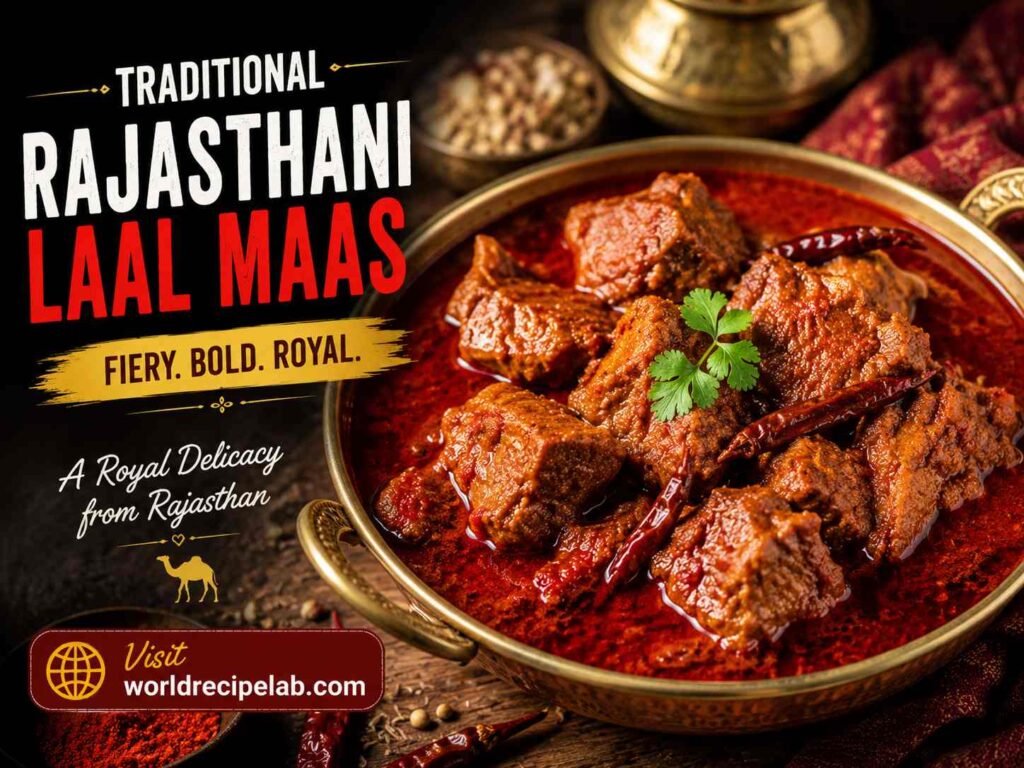
There are four ingredients that do most of the work in this curry:
Dried red chilies provide the characteristic color, chili flavor and heat.
Garlic gives the gravy its savory aromatic base.
Bone-in mutton adds richness as it cooks slowly.
Ghee carries the flavors of the chilies and whole spices and gives the finished curry a rounded richness.
Yogurt adds acidity and helps create a cohesive gravy without relying on tomatoes or cream.
The result should be a rich, spicy curry with tender mutton and enough gravy to coat the meat without becoming watery.
Mathania chilies are traditionally associated with Laal Maas and are prized for their red color and distinctive chili character.
However, dried chilies vary considerably in heat. Two batches of the same type can taste noticeably different depending on growing conditions, age and storage.
That means the number of chilies alone is not a reliable way to predict how hot your curry will be.
If Mathania chilies are unavailable, Kashmiri dried red chilies are a practical substitute. They generally provide strong color with less heat, although the flavor will not be identical.
For an even milder version, use more mild dried chilies and fewer hotter ones rather than reducing the chili paste so much that the curry loses its character.
Bone-in goat meat is an excellent choice for this curry. A shoulder cut works particularly well because it contains meat and connective tissue that benefit from slow cooking.
Mixed bone-in mutton pieces can also be used.
Lamb shoulder is a practical substitute if goat meat is unavailable, although the flavor will be different and the cooking time may vary.
Whatever meat you choose, judge doneness by tenderness, not simply by the clock.
| Detail | Amount |
|---|---|
| Prep Time | 20 minutes |
| Marination | 30 minutes |
| Cook Time | 1 hour 30 minutes |
| Total Time | 2 hours 20 minutes |
| Servings | 4 |
| Course | Main Course |
| Cuisine | Indian, Rajasthani |
Place 750 g bone-in mutton in a large mixing bowl.
Add the thick curd, ginger-garlic paste, turmeric and salt. Mix thoroughly until the mutton is evenly coated.
Cover and marinate for 30 minutes.
For a longer marinade, refrigerate it overnight, but bring the meat out according to safe food-handling practices before cooking.
Soak the Mathania chilies in warm water for 15–20 minutes.
Drain them and remove the seeds if desired.
Add the chilies to a blender with:
Blend into a smooth paste, adding a little water if necessary.
The paste does not need to be completely liquid. A thick, smooth paste is easier to cook properly.
Heat 4 tbsp ghee in a heavy-bottomed kadhai or handi.
Add the 2 bay leaves and let them become aromatic.
Add the thinly sliced onions and cook until golden brown.
Don't rush this stage. The onions should develop color without burning.
Add the prepared chili-garlic paste.
Cook over medium heat for 10–15 minutes, stirring regularly.
The paste should lose its raw aroma and become deeply aromatic. Watch the heat carefully because chili paste can catch on the bottom of the pan.
Add the marinated mutton to the cooked chili and onion mixture.
Stir thoroughly so the meat is coated in the masala.
Cook uncovered over medium heat for 15–20 minutes, stirring occasionally.
The mutton should become well coated and the masala should begin to look richer and more concentrated.
Pour in 1½–2 cups hot water, depending on how much gravy you want.
Season with additional salt if necessary.
Cover the pot and reduce the heat to low.
Simmer for 60–75 minutes, stirring occasionally.
Keep the cooking gentle. A strong boil can make it harder to control the gravy and can cause the masala to catch on the bottom.
The curry is ready when the mutton is tender and the gravy has developed a rich, cohesive consistency.
If the meat is still firm, continue cooking with enough liquid to prevent the bottom from drying out.
Taste the gravy and adjust the salt.
Once the mutton is fork-tender and the ghee has separated around the edges of the gravy, turn off the heat.
Allow the curry to rest for a few minutes before serving.
Serve hot with bajra roti, steamed rice, missi roti or ghee pulao.
Tender mutton is more important than following a rigid cooking time.
The final cooking time depends on factors such as:
Keep the curry at a gentle simmer and give the connective tissue enough time to soften.
If the meat is still tough when the gravy has already reduced considerably, add a little hot water, cover the pot and continue cooking.
Don't compensate for tough meat by turning the heat very high.
If you want a strongly colored curry without excessive heat, use a combination of milder dried red chilies and hotter chilies.
Use more Kashmiri dried red chilies and fewer hotter chilies.
Use a greater proportion of hotter dried red chilies.
It can reduce some of the heat, but it does not remove all of it. The flesh and other parts of the dried chili can still contain significant heat.
The safest approach is to control the type and quantity of chilies rather than relying only on deseeding.
This is the most practical substitution.
Kashmiri chilies generally provide excellent color with less heat. The finished curry will not taste exactly the same, but it remains a good home-kitchen alternative.
Use lamb shoulder or another suitable slow-cooking cut.
The flavor changes, and the cooking time may be different, so cook until tender rather than following the clock blindly.
A neutral oil can replace ghee if necessary.
The curry will have less buttery richness, but the chili and spice flavors will still come through.
Plain Greek yogurt can work well because it has a similar thick consistency.
If your yogurt is very thick, loosen it slightly before mixing it into the marinade.
Garlic paste is convenient, but freshly crushed garlic can provide a more pronounced aroma.
Don't add large amounts of water, as this can dilute the curry without actually fixing the heat.
A little additional plain curd can soften the perception of heat, although it will also change the texture and flavor slightly.
Serve the curry with plain rice, roti or a cooling yogurt accompaniment.
The chili paste or onions may have burned.
Chili paste needs moderate heat and frequent stirring. Once burnt, its bitterness can be difficult to remove.
Remove the lid and simmer gently until some of the excess moisture evaporates.
Avoid aggressive boiling, which can make the meat tough while the gravy reduces.
Add a small amount of hot water and simmer gently until you reach the consistency you want.
Keep cooking it gently.
Add a little hot water if necessary and continue until the meat becomes tender.
The color depends largely on the dried chilies used and how they are cooked.
Kashmiri chilies can provide strong color without adding as much heat as some hotter varieties.
Avoid simply adding excessive chili powder at the end, as that can leave an unpleasant raw spice flavor.
The stovetop method gives you good control over the texture and allows the gravy to gradually develop.
Use a heavy-bottomed kadhai, handi or Dutch oven-style pot.
Once the mutton and water are added, maintain a gentle simmer and check the liquid occasionally.
If the curry is reducing too quickly before the meat is tender, add a little hot water.
The curry is finished when the mutton is tender and the gravy is rich rather than watery.
Yes, a pressure cooker can shorten the cooking process.
However, the pressure-cooker method should still begin with properly cooking the onions and chili paste before adding the meat.
Because pressure cookers vary in size and pressure, it is better to cook until the mutton is tender rather than relying on one universal number of whistles.
After pressure cooking, simmer the curry uncovered if the gravy needs to be reduced.
For this reason, the stovetop recipe above remains the primary method for this page.
Laal Maas has a powerful flavor, so simple accompaniments work particularly well.
The earthy flavor of bajra roti pairs naturally with the spicy mutton gravy.
Plain rice gives the curry room to stand out and absorbs the rich gravy easily.
A lightly seasoned rice dish provides a richer pairing without introducing another strongly spiced curry.
Missi roti adds a hearty, nutty element that works well with the mutton.
A simple cucumber raita or plain yogurt can provide a cooling contrast to the chilies.
Transfer leftover Laal Maas to an airtight container once it has cooled appropriately.
Refrigerate for up to 3 days.
For longer storage, freeze it in a suitable freezer-safe container.
When reheating, warm it gently on the stovetop. If the gravy has become very thick, add a small splash of water before reheating.
Reheat only the portion you intend to eat rather than repeatedly reheating the entire batch.
It can.
After resting, the spices have more time to blend into the gravy, and the curry often tastes more integrated when reheated gently.
That makes Laal Maas a useful make-ahead dish for a planned meal.
Laal Maas is closely associated with Rajasthan and remains one of the region's best-known mutton preparations.
The dish is often connected with Rajput culinary traditions and royal or hunting cuisine, but specific historical stories about its origin are difficult to establish with certainty.
Rather than relying on a single origin story, what is clear is the dish's strong regional identity: mutton, dried red chilies, garlic, whole spices and slow cooking remain central to the style.
Laal Maas is a spicy Rajasthani mutton curry made with dried red chilies, garlic, whole spices and meat cooked until tender in a rich gravy.
Its color comes primarily from the dried red chilies used in the curry. Mathania chilies are traditionally associated with the dish, while Kashmiri chilies are a practical alternative when color is desired with less heat.
Not necessarily. Its heat depends on the type and quantity of dried chilies used. You can make a strongly colored curry with considerably less heat by choosing milder chilies.
Yes. Lamb shoulder is a suitable substitute, although its flavor and cooking time can differ from goat.
Yes. This recipe does not use tomatoes. Its flavor comes from chilies, garlic, yogurt, ghee and whole spices.
Cream is not necessary for this recipe. The richness comes from the mutton, ghee, yogurt and cooked chili-spice mixture.
Yes. Refrigerate it properly and reheat gently when serving. The flavors can become more integrated after resting.
Bone-in goat, particularly shoulder, is an excellent choice. Lamb shoulder is a practical alternative.
If you enjoy regional Indian mutton curries, explore these recipes next:
Laal Maas is at its best when the ingredients are allowed to do the work.
Choose good bone-in mutton, cook the chili paste carefully, keep the heat controlled and give the meat enough time to become tender. You don't need a long list of ingredients or a cream-heavy gravy to create a satisfying curry.
If you have Mathania chilies, use them. If not, Kashmiri dried red chilies provide a practical way to achieve the deep red color while keeping the heat more manageable.
Serve it with bajra roti or simple rice, and let the spicy chili-garlic gravy remain the centerpiece of the meal.
• For authentic flavor, use traditional Mathania chilies from Rajasthan.
• Kashmiri dry red chilies with a pinch of smoked paprika can be used as a substitute.
• Slow cooking develops deeper flavors, but a pressure cooker can be used for a quicker version.
• If the curry becomes too spicy, stir in a spoonful of curd before serving.
• Laal Maas pairs beautifully with bajra roti, steamed rice, cucumber raita, and chaas.
• Leftovers taste even better the next day after the spices mature.
• Store refrigerated in an airtight container for up to 3 days.